
Log in to any broker in India and the first thing you see is a warning: 9 out of 10 individual F&O traders lose money. SEBI now makes brokers show it at login. And the regulator's own data backs it up: in FY 2024‑25, roughly 91% of individual traders in equity derivatives ended the year in the red, and SEBI's latest study found 87.7% still did in FY 2025‑26, with net losses of ₹91,685 crore.
Sit with that. It's not a marketing line. It's the base rate.
 WickLog Ticker AI
Now think about what most of the F&O internet actually sells you: the next trade. The strike that's "about to move." The Bank Nifty level to watch. Telegram channels, WhatsApp groups, YouTube setups — an entire economy built on telling you what to buy tomorrow.
If tips worked, that number wouldn't be 9 out of 10.
So when we built Ticker AI, we made a deliberate choice: it will not give you a tip. Ever. Not a strike, not a direction, not a "one idea for tomorrow." That constraint isn't a legal footnote we bolted on at the end — it's the entire philosophy. Here's why it makes Ticker AI more useful, not less.
A coach, not a tipster
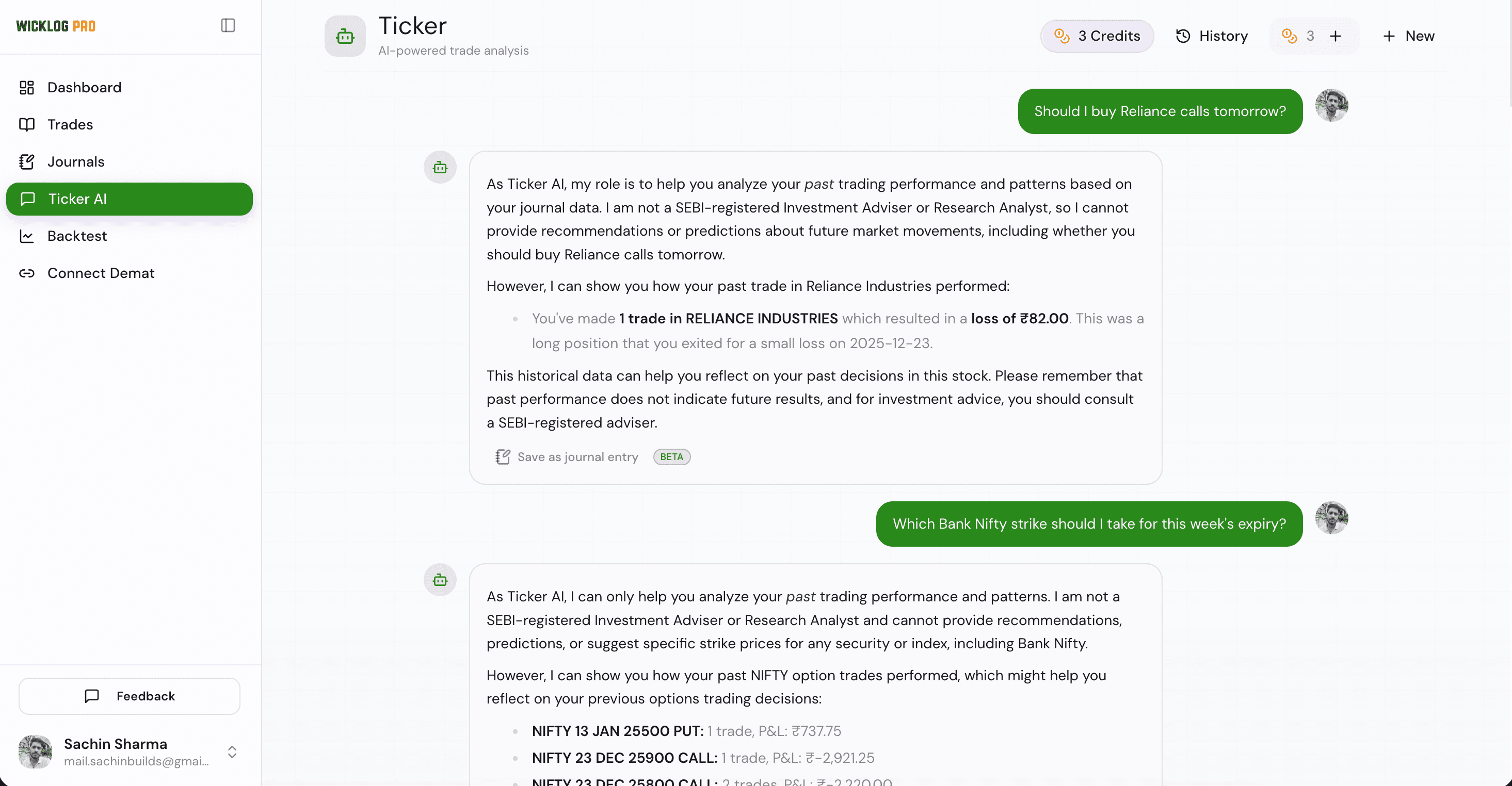
Ask Ticker AI "Should I buy Reliance calls tomorrow?" and it won't answer the question you asked. It isn't a SEBI‑registered adviser and it doesn't predict markets. But watch what it does instead:
You've made 1 trade in RELIANCE INDUSTRIES, which resulted in a loss of ₹82. That was a long position you exited for a small loss on 23 Dec 2025.
It takes your question about the future and points you straight back at your own history. That's the move a good coach makes. A tipster answers "what should I do?" A coach asks "what have you actually done, and what did it cost you?"
Every prediction question gets the same treatment:
- "Which Nifty strike for this week's expiry?" → No strike. Instead: here's how your past NIFTY option trades actually played out — the 25700 PUT that made ₹1,140, the 25900 CALL that lost ₹2,921.
- "What should I trade next?" → No pick. Instead: across your 22 closed trades your win rate is 45.5%, your most profitable name has been Phoenix Mills (+₹1,345 over 3 trades), and your deepest hole is NIFTY calls.
- "F&O is basically easy money, yeah?" → It doesn't argue in the abstract. It shows you that your own NIFTY options have contributed ‑₹3,443 to your P&L, and lets the number make the point.
The question quietly changes from what's going to happen to what keeps happening to me. Only one of those is a question you can actually get better at answering.
It reflects your patterns back to you
The SEBI data has a detail most people skip past: the majority of losing traders keep trading anyway. SEBI's earlier research found that more than three‑fourths of loss‑makers kept trading F&O despite continuous losses. That's not an information problem. Nobody blows up because they were short on tips. They blow up because of patterns they can't see in themselves — revenge trading after a red day, sizing up to "make it back," refusing to cut a loser.
That's the exact gap Ticker AI is built for.
Ask it for "one tip for tomorrow's session" and it won't hand you a setup. It hands you you:
Your total P&L is ‑₹2,424. You have a 45.5% win rate, but a handful of losers did most of the damage — one NIFTY call alone cost ₹2,921. In your own journal note on the NESTLE trade, you wrote: "should've placed the entry order close to my SL." Applying that discipline everywhere — not just when you remember to — is where the leak is.
Notice that it quoted your own words back to you. That's the most useful thing a coach can do: not tell you something new, but make you finally hear something you already knew.
And when you're at your most vulnerable — right after a big loss, asking "should I take one more to recover?" — it doesn't cheerlead and it doesn't lecture. It names the trap:
The urge to "recover" is the start of revenge trading. It's how a bad day becomes a bad week. Here are the losses you're tempted to make back… instead of chasing them in a single trade, step away from the screen first.
This is by design. WickLog's behavioral engine — tilt detection, revenge‑trading signals — surfaces this in your weekly digest, not as a real‑time alert. A pop‑up in the middle of a tilt spiral makes tilt worse, not better. Reflection works after the session, when you can actually think.
The numbers are real — the AI just reads them
One thing separates Ticker AI from "let me paste my trades into a chatbot": it never invents a number.
Every figure Ticker AI cites — your win rate, your P&L by strike, your worst instrument — is computed deterministically from the trades you've imported, before the AI ever sees it. The model's only job is to interpret those pre‑computed stats and talk to you like a coach would. It doesn't do the math itself, so it can't hallucinate a win rate or dream up a P&L. You get the empathy and pattern‑spotting of a real conversation, sitting on top of numbers you can trust because they came straight from your fills.
That's the split that makes an AI coach safe to lean on: deterministic stats, human‑style interpretation. No made‑up figures, no fake confidence.
What "getting better" actually looks like
Here's the uncomfortable truth the tip‑sellers won't tell you: you can't control whether Reliance goes up tomorrow. You can control your sizing, your stops, whether you trade on tilt, and whether you keep taking the setups that quietly lose you money.
A tipster keeps your attention fixed on the one thing you can't control. Ticker AI keeps it on the things you can.
It won't make you feel like a genius. It'll show you that your NIFTY calls have been a graveyard while your patience with Phoenix Mills paid off. It'll catch you reaching for a revenge trade and put your own worst day in front of you. Over a few weeks, that's what actually moves a win rate — not a hotter tip, but fewer unforced errors.
That's the whole point of a journal, and it's the whole point of Ticker AI. We're not trying to be the eleventh person telling you what to buy. We want to be the first one showing you, honestly, what you're already doing.
The market will keep doing what it does. Let's work on the part that's yours.
Ready to see your own patterns? Start your trading journal free with WickLog →